Mandalachart World
A thinking platform that integrates ideation, organization, and execution!
◆ What is Mandalachart?

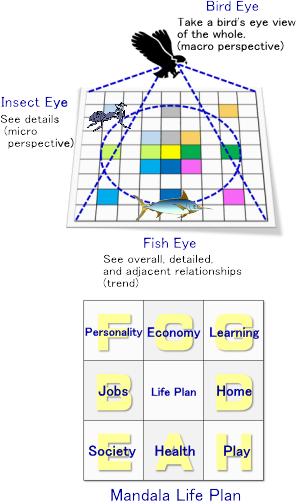
Mandalachart® is a 3x3 or 9x9 framework with a central core developed in 1979 by Mr. Yasuo Matsumura of Clover Management Research Institute to "enrich life and business".
By drawing and capturing the whole, parts, and relationships around a theme, realizations and inspiration are born. In addition, "Mandala thinking" that enriches life and business is behind it.
 Shohei Ohtani also uses it. |
Features 1. Visualizes your thoughts: Organizes ideas and issues in your mind, allowing you to grasp the overall picture at a glance. 2. Helps concretize goals: Abstract goals can be broken down into actionable tasks. 3. Prevents omissions and oversights: The 9-square structure allows for balanced and multifaceted thinking. |
| Why does the mandala chart cycle through the order "down, left, up, right, bottom left, top left, top right, bottom right" twice? | |
 |
Mr. Yasuo Matsumura, the developer of the Mandalachart, explains the reason
as follows: The Mandalachart has a "writing order." This is based on the structure of the Buddhist "Mandala (Vajradhatu Mandala)" and was established as a rule that best brings out human creativity. The first four steps: The cross directions of "down, left, up, and right" are squares where ideas are easily generated through linear thinking. The next four steps: By filling in the cross first, the brain's natural tendency to fill in the "remaining four corner spaces" (the brain's nature to dislike blank spaces) comes into play. Therefore, the four corners are then written in order from the bottom left. This is expected to have the effect of drawing out deeper ideas and unexpected ideas more easily than filling in from the top left. |
This Mandalachart Official App is an official app that complies with these.
Currently, the Mandalachart® is managed and operated by Mandalachart Association.
In addition, there is also a Mandalachart certified lecturer system, and more than 100 certified lecturers nationwide are practicing various activities from management support to individual life support.